


Toronto vs Vancouver: A Complete Comparison of Two Canadian Cities

Moving to Canada often comes with an important question: Toronto or Vancouver? These two major cities are among the most popular destinations for newcomers, offering very different lifestyles and opportunities.
In this guide, we provide a comprehensive comparison of Toronto and Vancouver, covering key topics such as weather, job and education opportunities, cost of living, social life, public transit, nature, and ease of integration for newcomers. By examining which city might be more livable for you in each of these aspects, we hope to answer common questions such as “Which city has better weather?” “What are the job prospects in Toronto vs Vancouver?”, and “Where will I feel more at home as a newcomer?” Let’s dive in and explore every angle of these two great Canadian cities, so you can make an informed decision about your future home.

Weather: Which Is More Livable?
When it comes to weather, Toronto and Vancouver could not be more different. In fact, approximately 3,300 km separates Toronto and Vancouver, which is roughly a 4.5- to 5-hour flight across Canada, so it's no surprise that their climates vary drastically.
Toronto has a continental climate with four distinct seasons, including hot summers and cold winters. In summer, Toronto can get very hot and humid, with temperatures often reaching 30-35°C (mid-90s °F) during heatwaves. Winters, on the other hand, are freezing cold. Temperatures in January and February frequently drop below freezing, sometimes plummeting to around -20°C (–4 °F) or even lower on the coldest days. Add in the wind chill, and it can feel even colder. Snow is a regular part of Toronto’s winters; the city experiences numerous snowstorms and a snowpack that can last for weeks. Toronto receives ~31.5 inches (80 cm) of precipitation per year, comprising both rain and snow. The upside is that Toronto often enjoys sunny, crisp winter days (albeit cold ones), as well as warm, sunny summers, perfect for enjoying the outdoors.
Vancouver has a mild, temperate climate thanks to its Pacific coastal location. Winters in Vancouver are relatively mild, with daytime temperatures usually in the 0 to 8°C range (30s to 40s °F). It's rare for Vancouver to drop much below freezing at sea level. Heavy snowfall is uncommon in the city (perhaps a few light snowfalls that melt quickly). Summers are pleasantly warm, but not as hot as Toronto, generally around 22–25°C, occasionally reaching 30°C on a particularly hot day. The primary factor influencing Vancouver's weather is rainfall. The city is known for its frequent rainfall and overcast skies, especially from fall through spring. It can rain for days on end in the winter, leading to the common description of Vancouver being a bit "gloomy" or grey during the winter months. However, unlike Toronto, when Vancouver gets precipitation in winter, it's usually rain at sea level (with snow in the surrounding mountains). Vancouver’s summers, by contrast, are relatively dry and sunny, with July and August being particularly beautiful and less humid than Toronto's.
Which climate is more livable? That depends on your preferences. Many people find Vancouver’s mild winters easier to handle; you won’t need to shovel snow or endure extreme cold. The trade-off is the rain and lack of sun in winter; some newcomers struggle with the long stretches of grey, wet weather. Toronto’s climate offers more sunshine in winter (on those frigid but bright days) and the beauty of four distinct seasons, but you must be prepared for snowstorms, icy sidewalks, and subzero temperatures for a few months. Summers in Toronto are hotter and more humid than those in Vancouver, which can be a pro or con depending on whether you enjoy the heat. In Vancouver, the summer heat is generally moderate and typically accompanied by low humidity.
In summary, Vancouver is generally a more livable climate-wise if you favor milder temperatures year-round and don’t mind rain, whereas Toronto might appeal if you love having hot summers and crisp, cold winters with plenty of sun in between.

Job and Education Opportunities
Both Toronto and Vancouver offer strong job markets and excellent education opportunities, but there are notable differences in their economies.
Toronto is often considered the economic engine of Canada. It’s the country’s largest city and its financial, corporate, and media capital. The Toronto Stock Exchange, major banks, and many multinational company headquarters are based in Toronto, making it a hub for finance, banking, and fintech. The city also boasts a diverse economy spanning finance, technology, healthcare, education, media, and manufacturing. This diversity translates into a broad range of job opportunities. If you’re in fields like banking, investment, consulting, or corporate law, Toronto likely has the lion’s share of those jobs. Likewise, Toronto’s tech sector has been growing rapidly, sometimes dubbed "Silicon Valley North,” with major companies and startups alike (especially in areas such as AI, software, and fintech). The unemployment rate in Toronto is generally low relative to national averages, reflecting the size and variety of its labor market. Simply put, Toronto offers more opportunities in terms of sheer volume, especially for corporate roles.
Vancouver, although smaller, has established a strong economy in specific sectors. The city is known as a hub for the tech industry, film and television production, tourism, and international trade. Vancouver’s tech scene has been rapidly growing, with many startups and established tech firms (like Amazon, Microsoft, and local startups) setting up large offices there. The film industry is so prominent that Vancouver is nicknamed “Hollywood North,” hosting countless film and TV productions each year. Its port location also makes it a gateway for trade with Asia, bolstering jobs in logistics, shipping, and sustainable resource management. Additionally, Vancouver’s focus on sustainability and green technology is creating jobs in environmental science and clean technology. The job market in Vancouver is robust but more specialized; it may not have as many corporate headquarters as Toronto, but if you’re in high-tech, entertainment, or sectors like animation and game design, Vancouver presents exciting prospects.
According to various reports, average annual salaries may vary by city; however, these figures fluctuate significantly depending on the sector, experience level, and position.
On the education front, both cities are top choices for students and have world-renowned institutions. Toronto is home to the University of Toronto (U of T), Canada’s highest-ranked university, which excels in research, medicine, engineering, and more. In addition, the city is home to York University, Toronto Metropolitan University (formerly Ryerson University), OCAD University (Canada’s premier art and design school), and several prestigious colleges, including George Brown College, Seneca College, Humber College, and Centennial College. This means that, regardless of your field, Toronto likely has a program or institution that caters to it. The large student population also presents numerous academic and professional networking opportunities in the city.
Vancouver’s flagship university is the University of British Columbia (UBC), consistently ranked among the top three universities in Canada and recognized globally for its excellence in fields such as forestry, computer science, and oceanography. Vancouver also boasts Simon Fraser University (SFU), which is highly regarded, especially in tech and business programs, as well as smaller universities and colleges such as Capilano University, Emily Carr University of Art + Design, and technical institutes like BCIT (British Columbia Institute of Technology). Additionally, like Toronto, Vancouver has community colleges (e.g., Langara, Douglas College) that offer diplomas and university transfer programs. Both cities attract tens of thousands of international students each year and offer a multicultural campus experience.
Networking and career prospects for graduates are strong in both cities. Toronto’s massive job market can be an advantage for internships and co-op placements (especially in finance, consulting, and healthcare). Vancouver’s close-knit tech and film community can offer unique inroads into those industries, and the city’s emphasis on work-life balance might appeal to those looking for a more relaxed start to their careers.
In summary, Toronto generally offers a greater quantity and variety of jobs due to its size and status as an economic hub. Vancouver offers quality opportunities in targeted industries; if those align with your career, it can be just as rewarding. From an education standpoint, you can receive a world-class education in either city, so your choice might depend on program specifics, campus culture, or scholarship opportunities. Think about your field of work or study: if it’s finance or media, Toronto might have an edge; if it’s tech or film, Vancouver could be ideal.
Cost of Living: Housing, Food, and Transportation
The cost of living is a crucial factor in the debate between Toronto and Vancouver. The bad news (for our wallets) is that both cities are among the most expensive in Canada. The good news is that salaries are also relatively high, and with careful planning, you can manage in either city. Let’s break down the main expenses:
Housing (Renting or Buying): Housing is typically the biggest expense. Toronto and Vancouver have notoriously expensive housing markets, though Vancouver often ranks as the priciest.
As of 2024, the average monthly rent for a one-bedroom apartment in downtown Vancouver is around $2,700 CAD, while in downtown Toronto it’s roughly $2,520 CAD. This indicates that Vancouver rents are slightly higher, but both are effectively steep. In recent years, the average monthly rent for a one-bedroom apartment in central areas of Vancouver and Toronto typically falls within this range, although prices may vary significantly depending on the neighborhood, building type, and rental conditions.
If you’re looking to buy property, median prices are well over $1 million in both cities. For example, the median price for a single-detached home in the Greater Toronto Area is approximately $1.27 million, and in Greater Vancouver, it’s around $1.35 million. Condos (apartments) are comparatively cheaper but still very expensive by Canadian standards, often in the $600k-$800k range for something centrally located. Vancouver’s housing prices have been driven up by limited land (surrounded by ocean and mountains) and high demand, whereas Toronto’s prices reflect the size and economic pull of the city. In summary, Vancouver has a slight edge in being more expensive for housing, as it regularly appears in lists of Canada’s most expensive cities to live in, but Toronto is not far behind.
Transportation: If you live in the city and use public transit, note that Toronto’s transit costs are higher. A monthly transit pass in Toronto (TTC) costs approximately $156 CAD, whereas in Vancouver (TransLink), it’s roughly $100 CAD for a one-zone pass (covering the city itself). Vancouver’s transit is zone-based, so if you commute from farther suburbs, you might pay more, but many find it cheaper overall. Gasoline and car insurance are also costs to consider if you drive. Car insurance in Vancouver (ICBC, a government-run insurance system) tends to be quite high; one estimate puts the average annual cost at $1,832, compared to approximately $1,528 in Toronto. Gas prices in Vancouver are often the highest in Canada (due in part to carbon taxes and location), whereas Toronto’s are a bit lower, but both fluctuate. If you plan to live without a car, both cities have decent transit (see the Public Transit section) and are reasonably walkable/bikeable in core areas.
Groceries and Food: Monthly grocery expenses can vary widely based on personal habits, dietary preferences, and shopping locations, though overall costs in Toronto and Vancouver remain broadly comparable.
Utilities and Other: Monthly utilities (electricity, heating, water) for a one-bedroom might average $150 in Vancouver and $200+ in Toronto. One reason is that Toronto’s hot summers and cold winters mean more air conditioning and heating use, whereas Vancouver’s milder climate can lead to lower heating costs (and many buildings in Vancouver don’t have/need AC). Internet and mobile phone plans are the same high cost in both cities (Canada has some of the highest telecom prices in the world, unfortunately), easily $80+ per month for a decent plan. Provincial sales tax rates differ slightly: Vancouver (BC) has a 12% combined sales tax, while Toronto (Ontario) has a 13% rate. Although this is not a huge difference, it is noticeable.
Salaries vs Expenses: It’s worth noting that while Vancouver’s average salaries can be slightly higher in certain fields, the cost-of-living “bite” can feel harsher because of housing. Many locals in Vancouver devote a significant portion of their income to rent or mortgages (the same is true in Toronto, although Toronto has more variation in pricing across its metro area). In both cities, many people save on rent by living with roommates or in suburban areas farther from downtown.
In conclusion, living in Vancouver or Toronto will require a healthy budget. If we had to split hairs, housing would likely cost you more in Vancouver, while other day-to-day expenses like groceries, utilities, and transit might cost a bit more in Toronto. Regardless, the difference isn’t night and day; both are costly compared to smaller Canadian cities. Your strategy in either case should be to plan ahead: consider living slightly outside the downtown core (where rents are lower), use public transit instead of owning a car if possible, and take advantage of cheaper entertainment options (like free community events or outdoor activities). Both cities have vibrant communities where people can enjoy life without breaking the bank, from farmers’ markets and free festivals to reasonably priced ethnic eateries. With a good job and sensible budgeting, you can have a high quality of life in either Toronto or Vancouver, but be prepared for those housing bills, which are typically the toughest part of the equation.

Social Life and Cultural Activities
When it comes to social life, the arts, and culture, Toronto and Vancouver each offer rich yet distinct experiences.
Toronto is often compared to New York City in terms of its cultural vibrancy; it's a big, bustling metropolis that “never sleeps.” If you love the buzz of city life, Toronto delivers. The city’s entertainment calendar is jam-packed year-round. It’s home to major events like the Toronto International Film Festival (TIFF), one of the world’s largest film festivals that draws movie stars and cinephiles every September. There are countless concerts, theater productions, art exhibitions, and festivals covering a wide range of genres, from jazz and indie music to comedy, as well as food, culture, and technology. For example, Toronto hosts Caribana (a huge Caribbean carnival parade) in the summer, Pride Toronto (one of the world’s largest LGBTQ+ pride festivals), multi-week events like the Toronto Christmas Market, and Nuit Blanche (an all-night art event), to name just a few. Sports fans will also find a lively scene in Toronto, which boasts professional teams in hockey (Maple Leafs), basketball (Raptors), baseball (Blue Jays), soccer (Toronto FC), and more. Attending games is a significant part of the social fabric for many. The nightlife in Toronto is diverse: from clubs and bars in the Entertainment District or King West, to cozy pubs and live music venues on Queen West, to trendy cocktail lounges, there’s something happening every night. Restaurants are another highlight of Toronto’s diverse culinary scene, reflecting its multicultural population. You can stroll through neighborhoods like Chinatown, Little Italy, Little India, Greektown, Koreatown, and find authentic international cuisines. In short, if you’re a city person who loves having endless options for things to do and people to meet, Toronto will not disappoint. The city’s size means you’re more likely to find niche communities and events related to your interests, whether that’s a book club, a tech meetup, a yoga class in the park, or a salsa dancing night.
Vancouver’s social scene is active yet more laid-back. Vancouverites definitely go out and have fun, but the city’s nightlife is not as extensive as Toronto’s. Large nightclubs are fewer, and the city is known to be a bit quieter in the late-night hours (in part due to stricter local bylaws on bar hours, etc.). That said, if you enjoy dining out, craft breweries, outdoor festivals, and the arts, Vancouver has plenty to offer. The city’s cultural diversity, while not as breadthwise deep as Toronto’s, is still significant. You’ll find areas like Richmond for amazing Asian cuisine (just south of Vancouver, reachable by SkyTrain), or Punjabi Market (Little India) on Main Street for Indian sweets and groceries. Vancouver boasts a strong coffee culture and numerous indie cafes where people socialize or work remotely. As for events, Vancouver hosts the Celebration of Light, an annual international fireworks competition over English Bay that attracts huge crowds in the summer. There’s also the Vancouver International Film Festival (VIFF) in the fall, the Vancouver Folk Music Festival, the Fringe Festival for theatre, and many other community events. The city’s setting means a lot of social life revolves around the outdoors: on a sunny weekend, you might join friends for a hike in the mountains, a bike ride around Stanley Park, or kayaking in False Creek. In the winter, a common social activity is heading up to Whistler or local ski hills for skiing/snowboarding. These outdoor adventures are a big part of Vancouver’s social fabric, and you’ll find many groups and Meetups dedicated to hiking, climbing, biking, etc. For nightlife, Vancouver has a concentrated area of bars and clubs on Granville Street downtown, as well as some trendy bars in neighborhoods like Yaletown, Gastown, and Main Street. Live music and theatre are present (for instance, the city has a Symphony Orchestra, opera, and several theatres), but on a smaller scale than in Toronto. One notable aspect: Vancouver’s scene, especially the downtown core, can feel younger and more casual, with brewpubs and patio bars populated by people in fleece jackets and hiking boots who have just come off the trails, versus Toronto’s downtown, where you might see more suits or formal attire at after-work hotspots.
In terms of meeting people and making friends, Toronto’s large size can be both a blessing and a curse. There are tons of people from everywhere (which is great), but it can also feel impersonal until you find your circle. Vancouver’s smaller size and common interest in outdoor activities can create an easy bonding experience, but some newcomers mention the “Vancouver freeze,” a term suggesting it can be a little challenging to break into social circles (though once you do, people are very friendly). This is anecdotal and can vary significantly from individual to individual.
To summarize, Toronto offers an endless, world-class array of cultural and social activities. It's the city for you if you thrive on big-city energy, night outings, and cultural events at every turn. Vancouver offers a more relaxed social life that takes full advantage of its natural surroundings. It's perfect if your idea of fun is a day outdoors followed by a craft beer with friends, and a city where things might wind down a little earlier at night. Both cities are multicultural and have many young professionals and students, so you’ll find open-minded, globally aware communities in each. Your personal hobbies and preferences (theatre vs hiking, clubbing vs camping) might sway you toward one city’s social scene over the other.
Public Transit and Inner-City Transport
Getting around efficiently is key in any city. Toronto and Vancouver both have well-developed public transit systems, but there are differences in scale and convenience.
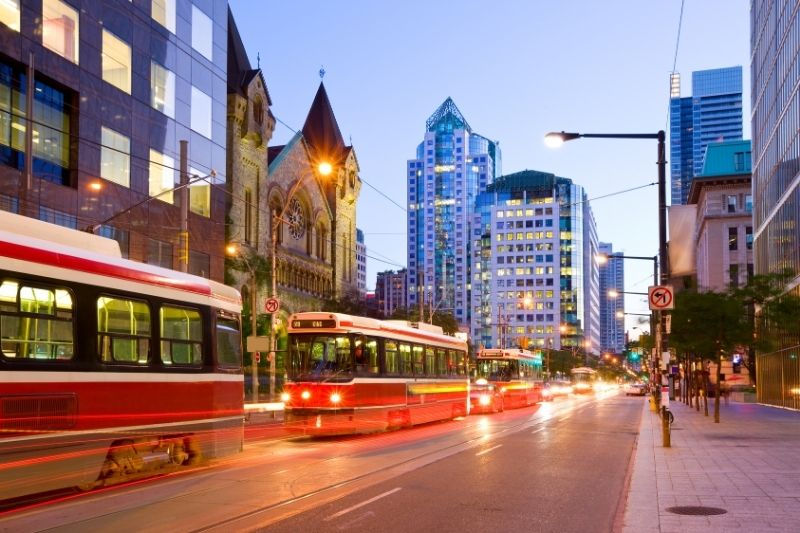
Toronto’s public transit is run by the Toronto Transit Commission (TTC), and it’s the largest transit system in Canada. It includes subways, streetcars, and buses. The TTC subway has four lines (two major lines running north-south, and two smaller lines running east-west) that service the city’s core and some outlying areas. Streetcars (trams) operate mainly in downtown and central neighborhoods, offering a charming, if sometimes slow, mode of transportation on the surface. Buses fill in the gaps, covering essentially every area that doesn’t have streetcar or subway service. You can generally get to within a short walk of where you need to go in Toronto using transit, especially in the city proper. For the suburbs and regional travel, Toronto also has GO Transit commuter trains and buses that connect downtown with the Greater Toronto Area (places like Mississauga, Brampton, Markham, etc.). However, because Toronto is so large and populous, crowding and delays can be a challenge. At rush hour, subways and streetcars are often packed, and any disruption (a stalled train, for instance) can impact tens of thousands of commuters. Toronto is also infamous for its traffic congestion – highways like the 401 and the Gardiner Expressway get extremely busy, and driving 20 km can sometimes take well over an hour. A report once ranked Toronto’s commute among the worst in North America. If you live and work downtown, you may not need a car at all (many downtown residents commute on foot or by transit). However, if your commute is from one suburb to another, you might find public transit lacking, necessitating the use of a car. Overall, Toronto’s transit is extensive and constantly improving (with new subway extensions and an under-construction light rail line, the Eglinton Crosstown), but it can be stressful during peak times.
Vancouver’s public transit is comparatively small but very efficient for the city’s needs. The system is run by TransLink and includes the SkyTrain, buses, SeaBus, and commuter rail. The SkyTrain is Vancouver’s light-metro system (mostly elevated trains) with three lines: the Expo Line, Millennium Line, and Canada Line. These driverless trains are frequent and known for being on time. They connect downtown Vancouver with cities like Burnaby, New Westminster, and Surrey (via the Expo/Millennium Lines), as well as with the airport and Richmond (via the Canada Line). If you live near a SkyTrain station, getting around is a breeze; you can often be downtown within 10-20 minutes from many parts of Metro Vancouver. SeaBus is a passenger ferry that connects downtown Vancouver to the North Shore (North Vancouver) across the Burrard Inlet, making it convenient for those who live/visit there. The bus network covers everywhere the SkyTrain doesn’t, including extensive routes in Vancouver and surrounding suburbs. Vancouver’s transit is consistently rated among the best in North America for customer satisfaction. Buses generally run on time, except in heavy traffic. Because the metro area is smaller, transit travel times are usually shorter than in Toronto. For instance, commuting 10 km might take 20-25 minutes in Vancouver versus maybe 30-40 minutes in Toronto (rough estimates). Vancouver also has a single unified fare system for all modes (compared to Toronto, which has separate fares for TTC vs GO Transit).
There is traffic in Vancouver, certainly anyone who’s been stuck on the Lions Gate Bridge or along Broadway at rush hour can attest to that, but in general, Vancouver’s commute times are shorter and its traffic less intense than Toronto’s.
Another aspect: cycling and walking. Both cities encourage these eco-friendly modes. Toronto has been expanding its network of bike lanes, and biking is common, though the harsh winters can be a deterrent for some months. Vancouver, with its milder weather, has a very active cycling community and extensive protected bike lanes (especially around downtown and False Creek). In fact, Vancouver frequently ranks as one of the most bike-friendly cities in North America. Walking is pleasant in the dense neighborhoods of both cities. You'll find that many residents in both Toronto and Vancouver can live car-free, especially if they stay within the city proper.
In terms of cost, as mentioned earlier, Vancouver transit is cheaper. Vancouver uses a zone system (fares start around $3.10 for 1 zone, up to ~$5.20 for 3 zones; most city travel is 1 zone) and caps daily/monthly spending, whereas Toronto has a flat fare (~$3.35) regardless of distance, and monthly passes for $156. If you intend to use transit daily in Toronto, the monthly pass is worth it; in Vancouver, a 2-zone monthly pass (if you commute from a suburb) costs approximately $136 (a 1-zone pass is around $102). Car ownership costs (fuel, insurance), we covered Vancouver insurance is pricey, gas is pricier than in Toronto, but distances driven might be shorter. Parking in downtown Toronto is notoriously expensive and scarce; Vancouver’s downtown parking is also not great, but the city is a bit easier to navigate by car outside of the core.
All things considered, Vancouver’s transport is a bit more convenient for most, simply due to scale and planning. Many Vancouverites find they don’t need a car, and commutes are often shorter. Toronto’s transport system is larger and offers more routes (especially with 24-hour bus services on many lines), but you might have a longer commute and face more crowds. If having a quick, hassle-free daily commute is a top priority, Vancouver might be the winner. However, if you value being in a big city where you might eventually want a car for weekend trips or reaching far-flung suburbs, Toronto’s extensive highways and grid might make sense (keeping in mind the traffic!). And if you plan to live centrally, both cities will serve you well, offering excellent public transit and walkability.
Nature and Outdoor Attractions
One of the most significant differences between Toronto and Vancouver is the access to nature and the variety of outdoor attractions each city offers.
Toronto, located in Southern Ontario, has natural attractions, but they’re a bit further afield. The city is situated on the shore of Lake Ontario, offering a lovely waterfront with parks and trails. The Toronto Islands, a short ferry ride from downtown, offer a great escape with beaches, biking paths, and a stunning skyline view of the city. Toronto’s largest downtown park, High Park, is a gem for a dose of greenery, complete with hiking trails, a small zoo, and cherry blossom trees that bloom in spring. The Don Valley and Rouge Park on the city’s edges also offer hiking opportunities within the city limits. However, when people think of Toronto and nature, the first thing that comes to mind is usually within a few hours’ drive: for instance, the majestic Niagara Falls is about a 1.5-hour drive from Toronto and is a must-visit natural wonder. Also, many Torontonians escape on summer weekends to “cottage country” in Muskoka or the Kawarthas – areas with hundreds of lakes, forests, and cabins about 2-3 hours north. These are fantastic for swimming, boating, and relaxing, but of course require travel. Within a day-trip distance, Toronto has access to places like Algonquin Provincial Park (famous for canoeing and autumn colors) and the Blue Mountain ski resort. Inside the city, beyond parks, Toronto’s attractions are more urban and cultural (CN Tower, museums, etc.), though the Scarborough Bluffs cliffs along the eastern waterfront offer a beautiful natural landscape in the city’s East End.
Vancouver is often considered one of the most naturally beautiful cities in the world, and for good reason. The city is surrounded by the ocean, mountains, and lush forests. Nature is truly at Vancouver’s doorstep. Right within the city, you have Stanley Park, a 1,000-acre urban rainforest with old-growth cedar trees, a seawall for cycling/jogging along the ocean, and beaches for summer relaxing. You can be in Stanley Park and forget you’re in a city at all. Vancouver’s North Shore (a short drive or SeaBus ride away) features the North Shore Mountains, Grouse Mountain, Cypress Mountain, and Mount Seymour, which are ski resorts in winter and hiking/biking destinations in summer. For example, a popular challenge is the Grouse Grind, a steep 2.8 km trail up Grouse Mountain that locals tackle for exercise. The reward at the top is a panoramic view of Vancouver, accompanied by perhaps a cold beer at the chalet. Vancouver has numerous easily accessible hikes, from easy trails in Lynn Canyon (with its own suspension bridge) to more advanced hikes in the backcountry (always go prepared!). Speaking of suspension bridges, the Capilano Suspension Bridge Park (though a bit touristy and with an entrance fee) is a famous attraction where you can walk across a swaying bridge high above a river gorge.
Beaches are another part of Vancouver life: Kitsilano (“Kits”) Beach and English Bay Beach are buzzing in summer with volleyball, sunbathing, and outdoor swimming pools. If you like water sports, Vancouver is perfect. You can kayak in False Creek or English Bay, paddleboard, or even take up surfing a bit further afield (Tofino on Vancouver Island is a surfing mecca). Weekend trips from Vancouver often involve stunning nature: within a 1–2-hour drive, you can be at Whistler Blackcomb, a world-class ski resort (and summer mountain biking/hiking destination). You can also explore the Sunshine Coast or Vancouver Island via ferry, which offer a rugged coastline, marine life (whale-watching tours are popular), and quaint coastal towns. Simply put, Vancouver is an outdoor enthusiast’s dream. It’s not unusual for locals to ski in the morning and sail or golf in the afternoon on a spring day.
One thing to note is that because nature is so integrated into Vancouver, even casual observers will encounter wildlife and greenery daily (for example, seeing coastal mountains in the background as you do your grocery shopping is normal). In Toronto, you might have to plan a bit more to get your deep nature fix, but the city does have lovely parks and ravines. Toronto's ravine network is often referred to as its hidden gem, weaving through the city with its trails and streams.
As for tourist attractions, Toronto’s top sights include the CN Tower, Royal Ontario Museum, Art Gallery of Ontario, Casa Loma (a historic castle), and perhaps a day trip to Niagara Falls. Vancouver’s top sights are often its natural ones: Stanley Park, Granville Island (market and arts hub), Capilano Suspension Bridge, Grouse Mountain, as well as attractions like the Vancouver Aquarium (in Stanley Park), and Science World. The city’s skyline against the mountain backdrop is in itself an attraction.
In summary, when it comes to daily access to breathtaking nature, Vancouver wins hands down. It’s hard to beat being minutes away from mountains and the sea. If grand cultural landmarks or proximity to world wonders are your thing, Toronto’s got the CN Tower and Niagara Falls within reach. Both cities have plenty to explore, but the flavor is different: Toronto is more about the urban experience with pockets of nature, while Vancouver is about nature at every turn, with pockets of urban life. Many newcomers find that Vancouver’s environment promotes an active, outdoor lifestyle, which can be a wonderful way to meet people and stay healthy. Toronto, on the other hand, offers a cultural “buzz” and a road-trip style of nature excursions. You really can’t go wrong but consider whether you prefer weekend adventures in the wilderness (Vancouver) or occasional getaways from dynamic city life (Toronto).
Ease of Integration for Newcomers
Moving to a new city, especially in a new country, can be daunting. The good news is that both Toronto and Vancouver are accustomed to welcoming newcomers, given their diverse populations and immigrant histories. However, there are nuances in the integration experience in each city.
Multicultural Communities: Toronto is often touted as one of the most multicultural cities in the world. Almost half of Toronto’s residents are immigrants born outside Canada. This means that, regardless of your origin, whether India, China, the Philippines, Nigeria, Turkey, Iran, or elsewhere, you will likely find a community of people from your country or culture in Toronto. There are culturally specific neighborhoods, community centers, places of worship, and associations. For example, there’s a significant South Asian community in areas like Brampton and Scarborough, a large Chinese community (Toronto has multiple Chinatowns, as well as suburbs like Markham/Richmond Hill with Chinese-majority populations), Italian and Portuguese enclaves, and so on. For newcomers, this diversity can be comforting you might find grocery stores selling your favorite hometown foods or meet neighbors who speak your language. Vancouver is also diverse, but its diversity is somewhat narrower. Vancouver’s immigrant population is large (around 40%+ of Metro Vancouver’s residents are foreign-born), with especially prominent communities of Chinese, Indian (Punjabi), Filipino, Iranian, and British heritage. In fact, roughly one-third of Vancouver’s population is of Chinese origin, giving the city a strong Asian influence in its culture and food (which is a plus for many!). Vancouver boasts vibrant Punjabi markets, two major Chinatowns (one in the city and one in Richmond), a large Filipino community, and others. Smaller communities (e.g., Latin American, African, Middle Eastern) are also present, although not as numerous as in Toronto. Both cities celebrate multiculturalism with events (Toronto’s Caribana, Vancouver’s Chinese New Year parade, for instance).
Community Support: As a newcomer, access to support services can significantly ease the integration process. Toronto, being larger, has an abundance of settlement services, newcomer centers, and language classes (ESL), often funded by government or NGOs. The city’s scale means more organizations, but sometimes it also means you have to actively seek them out. Vancouver also has excellent newcomer service organizations, such as S.U.C.C.E.S.S. and MOSAIC, that provide settlement help, language training, and employment workshops, among other services. Because Vancouver’s immigrant population is slightly smaller, some newcomers feel they get more personal attention, but that can vary. Both cities have community centers in many neighborhoods, offering a range of activities from leisure to integration programs.
Job Market Integration: We touched on job opportunities earlier, but integration-wise, the larger immigrant populations in Toronto mean you may find more professional networks and mentorship programs specifically designed for immigrants. For example, Toronto has programs like TRIEC (Toronto Region Immigrant Employment Council) that help newcomers establish professional connections. Vancouver has similar programs on a smaller scale. Credential recognition and finding work in your field can be a challenge anywhere, but certain fields in Toronto (finance, corporate, healthcare) might have clearer pathways if you have international credentials, while Vancouver’s job market might favor those in tech or who can leverage connections.
Making Friends and Social Integration: Culturally, Canadians are known to be polite and welcoming; however, forming deep friendships can take time, regardless of location. Some newcomers note that Torontonians, while friendly, can be busy and somewhat reserved (due to a big city mentality), so you need to put effort into socializing, joining clubs, and volunteering, among other things. On the other hand, because Toronto has many newcomers, locals are accustomed to people from elsewhere and are often curious about your story. Vancouverites have a reputation of being very polite and laid-back, but there’s the aforementioned “Vancouver freeze” idea, where it might take longer to become close friends (possibly because many social circles are formed around outdoor activities or were established earlier among locals). Of course, these are generalizations. Your experience will also depend on your own initiative. Both cities have plenty of Meetup groups and community events. In Toronto, you might join a meetup for entrepreneurs or a pickup soccer league; in Vancouver, you might join a hiking group or a ski club and meet people.
Lifestyle and Adaptation: For daily life, think about climate (as discussed). If you’re coming from a tropical country, Toronto’s winter will be a shock at first; Vancouver’s winter will be wetter but far gentler. Vancouver’s more casual lifestyle might mean you don’t need to rush out and buy formal attire; Toronto’s faster pace might push you to adapt to a hurry-up lifestyle (think catching the next subway or rushing through crowds on Bay Street). If you prefer a more relaxed pace, Vancouver integrates that into its culture; if you thrive on high energy and hustle, Toronto provides it.
Family and Children: Both cities are family-friendly in their own ways. Toronto has more options in terms of schools (and specialized programs) simply because of its size; Vancouver’s schools are also excellent, and perhaps more likely to have English as a Second Language (ESL) support, concentrated in areas like Richmond or Surrey, due to the larger proportion of immigrant children in these areas. Crime rates in both cities are relatively low. Canada's cities are generally safe, but Toronto, being a larger city, does have some neighborhoods with higher crime rates (mostly property crime). Vancouver’s safety concern is often centered on a very specific area (the Downtown Eastside) where there are visible homelessness and drug-related issues; it’s a complex social issue, but it’s largely contained to certain blocks and unlikely to directly affect newcomers beyond awareness.
Integration bottom line: Toronto offers the comfort of a massive, diasporically rich city. You can find a slice of home somewhere in Toronto, and you’ll be one of many newcomers figuring things out, which can be reassuring. It’s a place where you can blend in easily because everyone is from somewhere. Vancouver offers the ease of a smaller city where life’s a bit less frenetic, potentially making day-to-day navigation a bit less stressful for some. The presence of strong Asian and South Asian communities means that if you’re from those backgrounds, Vancouver has sizable networks that might make you feel at home. Either way, Canadians in both cities tend to be welcoming, tolerant, and used to diversity, so you’ll not be alone in your journey.
For both Toronto and Vancouver, a key integration tip is to get involved, whether through community centers, local meetup groups, religious communities, sports, or volunteering. Both cities offer numerous opportunities to connect, but you may need to take the initial step.

We’re Here to Support You in Choosing the City That Fits You Best
Deciding between Toronto and Vancouver depends on many factors, including your expectations, budget, education or career plans, and what you look for in a city lifestyle. For this reason, approaching the decision not only as a city choice but as part of your overall life planning in Canada often provides a clearer and more sustainable perspective.
At C&C Education, Visa and Immigration Canada, we understand that the needs of students and newcomers arriving in Canada extend far beyond academic considerations. When choosing a city, factors such as climate, employment opportunities, and educational opportunities are just as important as budget planning, accommodation arrangements, daily living dynamics, and alignment with long-term goals. For this reason, we view the process not merely as a school or city selection, but as part of a broader journey.
Our counselling approach is structured to consider not only current goals, but also the options that may emerge over time. For those planning to transition from language education to an academic program, the timing of this transition, the necessary preparations, and the overall process are evaluated together. Likewise, for individuals planning short-term education, the focus is on ensuring that the living process in Canada progresses as smoothly and realistically as possible.
The orientation period after arrival is often one of the most critical stages for newcomers. Understanding city transportation, settling into accommodation, organizing essential daily needs, and adapting to everyday life can be just as important as the education plan itself. Our aim at this stage is to support you in feeling more prepared, secure, and informed from your very first days in Canada.
If you would like to clarify your decision between Toronto and Vancouver, evaluate each city’s opportunities based on your personal goals, or discuss your plans for moving to Canada in a more structured way, you are always welcome to reach out to us. We recognize the importance of moving forward with accurate information and of feeling supported throughout this journey. We aim to make your experience as clear, sustainable, and predictable as possible.
C&C's In-Depth Expertise and Knowledge
Our team has extensive and detailed knowledge of Canada's immigration laws and regulations. This guarantees that we provide you with the most up-to-date and accurate guidance.
Ethical and Professional Consulting at C&C
We offer strategic and professional advice, always putting our clients' interests first and adhering to ethical values.
Transparent Pricing at C&C
We, at C&C Education and Immigration Consultancy in Canada, are committed to providing valuable services without surprise fees, by clearly and openly stating the cost of our services.
Flexible Personalized Approaches in C&C
We understand the unique needs of each client and accordingly take a flexible approach to provide tailored solutions to suit your individual goals and circumstances.
Outstanding Customer Satisfaction at C&C
With the excellent service quality we offer to our customers, we aim to establish lasting relationships based on trust by meeting their needs smoothly and with satisfaction.



Comments